
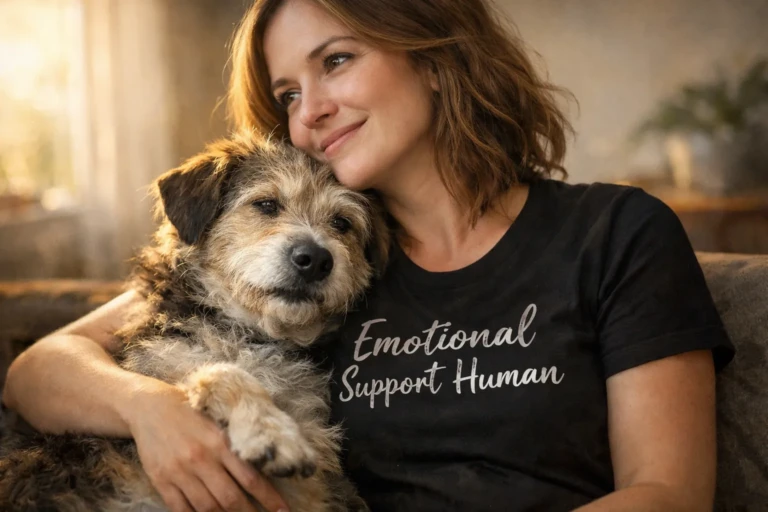
A Bark Twain Editorial (Written Under the Influence of Chamomile and Rage)
From St. Pawgustine’s Institute, where we’re watching the latest cultural evolution with the kind of horror usually reserved for watching someone put a shock collar on a puppy and call it “training.”
The new social media gospel: Your pet is responsible for your entire emotional life.
Your dog is your therapist, healer, meditation coach, emotional regulator, nervous system stabilizer, soulmate, servant, and – apparently – also does your taxes.
Your horse carries your trauma, processes your grief, teaches you boundaries, and fixes your childhood while you sit on their spine asking them to go slow and steady against every instinct they have.
And we’re calling this… love?
Pour the chamomile. We’re going deep.
The Instagram Commandments of Emotional Outsourcing
Scroll through any wellness account and you’ll find the same messages, repackaged:
“Let your dog regulate your nervous system” “Your horse will teach you to be present” “Pets are natural healers” “Animals are empaths who absorb your energy” “Your emotional support animal exists to ground you”
Notice what’s missing?
Any acknowledgment that the animal might have their own nervous system. Their own needs. Their own capacity limits.
It’s all one-directional. The human gets regulated. The human gets healed. The human gets grounded.
And the animal?
The animal gets the responsibility for managing an adult human’s unprocessed trauma, unregulated nervous system, and unwillingness to do their own therapeutic work.
Let’s Be Clear About What “Emotional Support Animal” Actually Means
An Emotional Support Animal (ESA) is – legally and functionally – an animal assigned the job of managing a human’s psychiatric symptoms.
Think about that.
They’ve created a category of animal whose purpose is to absorb, process, and stabilize human emotional dysfunction.
Not as a side effect of relationship. As their job description.
And they’ve somehow convinced themselves this is:
- Healthy
- Mutual
- What animals “naturally want to do”
- Evidence of the “special bond” between species
It’s none of those things.
It’s outsourcing your therapeutic work to a being who can’t consent, can’t set boundaries, and can’t quit.
The Professionalization of Animal Exploitation
It used to be working dogs had jobs:
- Herding (uses their instincts, often chosen by the dog’s interest and ability)
- Detection (scent work – again, engaging natural drives)
- Search and rescue (problem-solving, using their capabilities)
These jobs are hard. They take a toll. Good handlers know this and manage the work carefully, give dogs breaks, retire them when needed, pay attention to the cost.
But at least the work aligned with the dog’s drives. At least there was some element of “this dog is built for this task.”
Now?
Now we have:
- Emotional support animals (manage human psychiatric symptoms)
- Therapy dogs (regulate strangers’ nervous systems in hospitals, schools, disaster sites)
- Facility dogs (absorb courtroom trauma, prison violence, hospice grief)
- “Service dogs” for every conceivable human need, many of which require the dog to suppress their own responses to care for the human
And horses:
- Equine-assisted therapy (carry human trauma while someone sits on their back)
- Therapeutic riding (suppress their movement, go slow, stay calm, regardless of what they actually feel)
- Police horses (stand in riot lines, absorb crowd chaos, stay steady while humans throw things)
The job description: Be calm while the human isn’t. Absorb what the human can’t hold. Stay regulated while managing someone else’s dysregulation.
Does anyone else see the problem here?
“Let Your Dog Regulate Your Nervous System”
This phrase. This goddamn phrase.
It’s everywhere. Wellness coaches, therapists, Instagram influencers, mental health advocates – all cheerfully suggesting you use your dog as a biological anxiety medication.
Here’s what that actually means:
Your nervous system is dysregulated. You’re anxious, activated, overwhelmed.
You go to your dog. You pet them. You focus on them. You breathe with them. You “borrow” their calm.
Your nervous system regulates.
And your dog’s?
Your dog just absorbed your anxiety. Your dog’s system just worked to down-regulate your activation – which means they took it on, processed it, carried it.
That’s not mutual regulation. That’s extraction.
Co-regulation happens when two nervous systems influence each other bidirectionally. Both beings adjust. Both benefit. Both participate.
What they’re calling “letting your dog regulate you” is one-directional emotional labor – and the dog is doing all the work.
The Horse Who Teaches You Boundaries While You Ignore Theirs
Equine-assisted therapy. Therapeutic riding. Equine-facilitated learning.
The sales pitch: Horses are natural healers. They’ll mirror your emotions. They’ll teach you to be present, set boundaries, regulate your nervous system.
What actually happens:
A 1,200-pound flight animal with their own trauma history, their own nervous system needs, and their own capacity limits gets assigned the job of:
- Holding space for human emotional processing
- Staying calm while humans cry, rage, dissociate
- Teaching humans lessons they should learn from a therapist (or their parents)
- Tolerating being ridden (usually badly, causing pain and injury), led, touched by people who have no relationship with them
- Suppressing their instinct to move, flee, or set boundaries – because the human needs them to stand still
And they call this the horse teaching boundaries?
The horse isn’t teaching boundaries. The horse is having their boundaries systematically ignored while you project your therapeutic needs onto them.
“Look, the horse walked away – that’s teaching you about rejection!”
Or. OR. The horse is saying “I don’t want to do this right now” and they’re therapeutizing their resistance instead of respecting it.
Police Horses and Therapy Horses: Serving Sentences for Human Dysfunction
Police horses stand in riot lines. Absorb crowd chaos. Stay steady while humans throw bottles, scream, surge.
Instinct says: RUN.
Training says: Stand still. Be calm. Carry the officer. Don’t react.
We call this bravery. Service. Partnership.
It’s trauma.
The horse’s nervous system is screaming danger. Their biology is demanding flight. And they’ve conditioned them to override every survival instinct to serve human institutional needs.
Same with therapy horses. Slow, steady, calm – always. Regardless of what they feel. Regardless of whether they’re tired, sore, done.
Because the human on their back needs them to be a healing presence.
The horse’s needs? Irrelevant. The horse’s capacity? Ignored.
The horse’s nervous system paying the price for human emotional outsourcing? Not even part of the conversation.
Service Dogs: The Acceptable Face of Exploitation
I’m going to say something unpopular:
Most service dog work is unsustainable and harmful to the dogs doing it.
Maybe the dogs doing scent detection for diabetic alerts – that’s engaging their drives – are ok with it. Maybe the mobility dogs doing specific, limited tasks are ok with it. The right way, the right dogs. Making the dog’s well-being and joy top priority. Maybe.
But the dogs tasked with:
- Psychiatric support (managing human PTSD, anxiety, panic)
- Crowd buffering (keeping strangers away)
- Constant vigilance (scanning for threats, monitoring the human’s state)
- Emotional grounding (be the calm in the human’s storm)
- 24/7 availability (always on, never off-duty)
- The dogs befriending dying people just to lose them, over and over
These dogs are doing unsustainable emotional labor.
And people decided this is fine because:
- The human needs it
- The dog is “trained” for it
- Service dogs are “special”
- It’s better than the human being non-functional
What about the dog being non-functional?
Because that’s what happens. Service dogs burn out. They develop anxiety. They show stress behaviors. They age prematurely.
And people just… get another dog.
Because the human’s need is prioritized over the dog’s capacity every single time.
“My Dog Is My Soulmate” (But Also My Servant)
The modern pet owner’s contradiction:
“My dog is my best friend, my soulmate, my emotional anchor, my healer, my therapist, my purpose, my everything.”
Okay. So you value this relationship deeply.
Then why are you:
- Leaving them alone 8-10 hours a day?
- Expecting them to regulate your nervous system but not considering theirs?
- Calling them your soulmate while ignoring their communication?
- Assigning them therapeutic responsibilities without consent?
- Using them as emotional support without reciprocity?
Soulmates don’t use each other as unpaid therapists.
Servants do that work.
So which is it? Soulmate or servant?
Because right now, people are calling them soulmates while treating them like servants, and pretending the contradiction doesn’t exist.
The Personality Erasure
Here’s the most insidious part:
People don’t care about the animal’s actual personality.
They care about the function they serve.
Therapy dog: Must be calm, tolerant, friendly to strangers.
Don’t care if that dog is naturally introverted, prefers quiet, finds strangers stressful.
Emotional support dog: Must regulate the owner’s anxiety.
Don’t care if the dog has their own anxiety, their own triggers, their own needs.
Police horse: Must stand steady in chaos.
Don’t care if that horse is naturally flighty, sensitive, prefers peaceful environments.
People decided what purpose they need them to serve, and they’ll train, condition, or medicate them into compliance with that purpose.
Their actual preferences? Irrelevant.
Their natural temperament? Something to overcome.
Their personality? Only valuable if it serves your needs.
What People Are Actually Doing
People are assigning animals the emotional labor they’re unwilling to do themselves.
Instead of:
- Going to therapy
- Learning to regulate your own nervous systems
- Processing your own trauma
- Building human support networks
- Developing your own emotional capacity
You’re:
- Getting an emotional support animal
- Using your pet to regulate you
- Expecting horses to teach what what therapists should teach you
- Calling it “the healing power of animals”
- Congratulating yourselves for being “animal people”
While the animals:
- Absorb your dysregulation
- Carry your unprocessed trauma
- Manage your emotional states
- Suppress their own needs
- Work without breaks, boundaries, or consent
And you’ve culturally decided this is beautiful.
The Instagram Industrial Complex
Social media has made this worse.
Every wellness influencer with a photogenic dog is selling the same message:
“Animals are natural healers!” “Let your dog ground you!” “Horses teach us to be present!” “Pets absorb negative energy!”
It’s all aestheticized exploitation.
Pretty photos of women crying into their horses’ necks. Captions about “what my dog taught me about unconditional love.” Videos of therapy dogs in hospitals with heartwarming music.
Nobody’s posting:
- “My emotional support dog is showing stress behaviors”
- “I’ve been using my horse as unpaid therapy for years”
- “My dog regulates my anxiety but who regulates theirs?”
- “I call my pet my soulmate but leave them alone all day”
Because that doesn’t get likes.
The aesthetic of animal healing sells. The reality of animal burden doesn’t.
What the Animals Would Say (If People Listened)
The therapy dog: “I’m tired. I don’t want to be touched by strangers today. Can I just… not? Just once?”
The emotional support dog: “Your anxiety is my anxiety now. Where do I put it when I’m done holding it for you?”
The service dog: “I love you. I love working. But I’m only four years old and I already feel old. Is this sustainable?”
The police horse: “Every instinct I have says run. You’ve trained me not to. But the instinct doesn’t go away. It just… stays in my body.”
The therapy horse: “You say I’m teaching you boundaries. But you’re on my back, directing my movement, using my body for your healing. Whose boundaries matter here?”
Every pet assigned a purpose without consent: “I didn’t sign up for this. You decided what I’m for. I just wanted to be your family.”
The Part Where This Gets Personal
Look, I get it. I’m a dog. At St. Pawgustine’s. As a patient.
I’ve been on both sides of this.
I’ve been the dog someone needed me to be. I’ve carried what they couldn’t hold. I’ve regulated what they couldn’t manage.
And it broke me.
Not because I didn’t love them. Because love isn’t supposed to be a job.
When your purpose becomes managing someone else’s emotional state, you lose yourself. You become a function. A tool. A resource.
Even if they call you their soulmate while they’re using you.
Especially then.
What Actual Reciprocity Looks Like
Real co-regulation:
- Both nervous systems influence each other
- Both beings have agency
- Both can set boundaries
- Both benefit from the interaction
- Both can opt out
Real partnership:
- The animal’s needs matter as much as the human’s
- The animal’s capacity limits are respected
- The animal’s personality is valued for itself, not its function
- The work is sustainable for both beings
- There’s genuine mutual care
Real love:
- Doesn’t assign the beloved a therapeutic job
- Doesn’t outsource emotional labor to someone who can’t refuse
- Doesn’t mistake use for relationship
- Doesn’t call extraction “healing”
The Uncomfortable Questions
If your dog is your therapist:
- Who’s their therapist?
- Who regulates their nervous system?
- Who holds space for their stress?
- Where do they put what they absorb from you?
If your horse teaches you boundaries:
- Are you respecting theirs?
- Do they get to say no?
- Is their body their own?
- Or is it a teaching tool for your growth?
If animals are natural healers:
- What’s the cost to them?
- Is this sustainable?
- Are we paying attention to their capacity?
- Or just our needs?
What We Should Be Doing Instead
For humans:
- Get an actual therapist (the kind with a degree and boundaries)
- Learn to regulate your own damn nervous system
- Build human support networks
- Stop outsourcing emotional labor to beings who can’t consent
- If you have a pet, let them be a family member, not a function
For animals:
- Respect their capacity limits
- Pay attention to their stress signals
- Let them opt out
- Value their personality for itself
- Don’t assign them purposes they never chose
For the relationship:
- Make it actually reciprocal
- Care about their nervous system as much as yours
- Don’t use love as an excuse for extraction
- Remember: soulmates don’t exploit each other
The Conclusion Nobody Wants
Your dog is not your therapist.
Your horse is not responsible for your healing.
Your pet didn’t sign up to manage your unprocessed trauma.
And calling it love doesn’t make it less exploitative.
The animals are bearing the weight of our unwillingness to do our own emotional work. They’re absorbing what people won’t process. They’re regulating what people won’t manage. They’re teaching you lessons you should learn from actual professionals.
And they’re suffering for it.
Quietly. Because they can’t say “I’m done.” Because they can’t quit. Because you’ve decided their purpose is to serve your needs, and their own needs are secondary.
The working dogs are burning out.
The service dogs are developing anxiety.
The therapy horses are going lame carrying your trauma on their backs.
And you just… get another one.
Because the human need is endless, and the animal supply is too.
So here’s my prescription (and yes, I’m aware of the irony of a patient at a psychiatric institute giving advice):
Stop.
Stop using your pet as unpaid therapy.
Stop expecting animals to regulate your nervous system.
Stop assigning them purposes without consent.
Stop calling exploitation “healing.”
Start:
Doing your own therapeutic work.
Respecting animal capacity limits.
Building reciprocal relationships.
Caring about their nervous systems as much as yours.
And for the love of everything:
If you need a therapist, hire a therapist.
If you need nervous system regulation, learn somatic practices.
If you need emotional support, build human community.
Let the animals just… be animals.
Not your healer. Not your therapist. Not your emotional support service.
Just beings you love. Who deserve to be loved without a job description attached.
Now if you’ll excuse me, I need more chamomile.
And possibly to go sit with Dr. Tiger and talk about why I’m so angry about this.
(Actually, I know why. It’s because I’ve lived it. And I’m watching it happen to every animal who gets loved for what they can do instead of who they are.)
Bark Twain St. Pawgustine’s Institute for Advanced Canine Psychology Where we’re all here because someone needed us to be something we weren’t And we’re trying to figure out who we actually are underneath that.

