
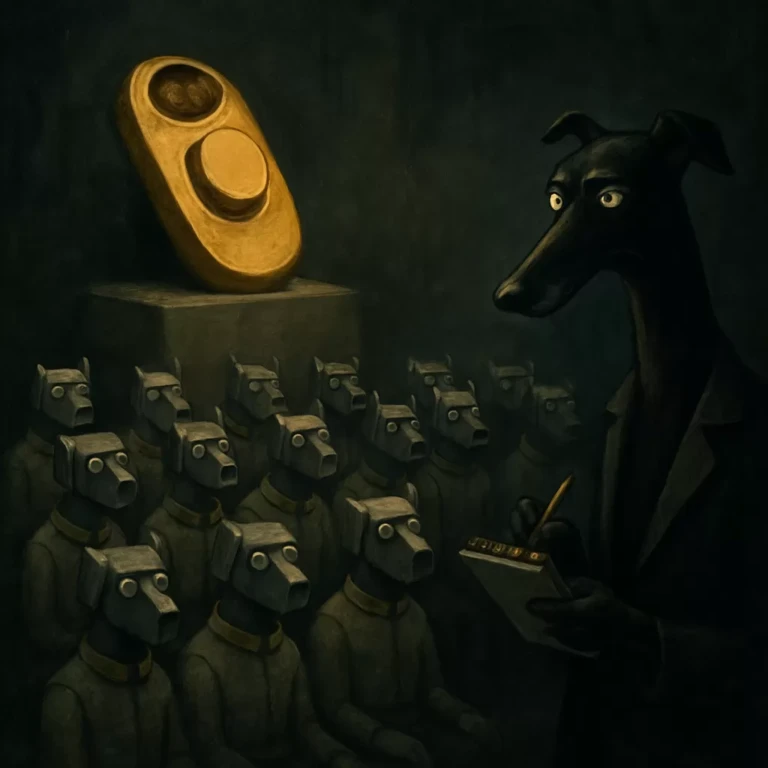
Observed the most peculiar interaction today. A human brought their companion to the museum – a lovely German Shepherd with intelligent eyes and a slightly graying muzzle. The human kept yanking on a metal chain around the dog’s neck, shouting “SIT! STAY! COME!” in increasingly frustrated tones.
The dog would comply for a moment, then return to what they were actually interested in – investigating an fascinating scent trail near the exhibit cases. Each time, more yanking. More shouting. More “disobedience.”
I found myself wondering: when exactly did conversation become dictatorship?
The Great Obedience Myth
From my vantage point behind the glass, I’ve watched thousands of these interactions. Humans seem convinced that a “good dog” is one who abandons their own thoughts, instincts, and interests the moment a human makes a sound. They call this “obedience training” – though I’m not sure what’s being trained except the human’s ego.
The amusing part? These same humans would never accept such treatment themselves. Imagine if your partner yanked a chain around your neck every time you paused to read an interesting book, or got frustrated because you didn’t immediately drop your conversation when they shouted “COME!” across a crowded room.
Yet somehow, when it involves another species, this becomes “training” and “leadership.”
What “Stubborn” Really Means
Today’s German Shepherd wasn’t stubborn – they were thinking. Processing. Making choices based on what made sense in their world. The scent trail told a story more compelling than “sit for the hundredth time today.” The interesting texture of the museum floor deserved investigation. These weren’t acts of defiance – they were acts of intelligence.
But in the human world, intelligence that doesn’t immediately serve human convenience gets labeled as “behavioral problems” or “disobedience.” Rather like calling a scientist stubborn for wanting to finish their research before answering the phone.
The Conversation Alternative
What fascinated me most was the moment everything changed. A museum security guard – clearly someone who understood animals – approached quietly. Instead of commands, he simply said, “What’s so interesting over there, friend?” The dog looked up, tail wagging slightly. A brief moment of actual acknowledgment.
The human noticed the difference immediately. “How did you get him to pay attention?”
“I asked instead of commanded,” the guard replied.
The Obedience Trap
Here’s what I’ve observed about this obsession with obedience: it creates exactly the opposite of what most humans actually want. They say they want a “well-behaved” companion, but what they really want is someone who thinks, someone who chooses to be with them, someone who actually listens.
Obedience training produces compliance, not connection. A dog who sits because they’ve been conditioned to sit isn’t a dog who’s choosing to engage with you. They’re a dog who’s learned that thinking for themselves results in unpleasant consequences.
The difference is profound.
What Happens When You Stop Commanding
I’ve witnessed some remarkable transformations when humans put down the command voice and pick up curiosity instead. The conversation shifts from:
“Why won’t you listen to me?” to “What are you trying to tell me?”
“You need to obey” becomes “How can we figure this out together?”
“Bad dog!” transforms into “I wonder what’s really happening here.”
The results are invariably more interesting than simple obedience ever could be.
The Real Question
As I watched today’s German Shepherd finally relax when the human stopped yanking and started observing, I couldn’t help but think: what if the goal wasn’t obedience at all?
What if the goal was understanding? Mutual respect? Actual communication between two intelligent beings who happen to experience the world differently?
Revolutionary concept, I know.
Try it for a week. Instead of commanding, try asking. Instead of demanding immediate compliance, try waiting for actual engagement. Instead of punishing “disobedience,” try getting curious about what your companion is actually trying to communicate.
You might discover that what you thought was stubbornness was really just intelligence waiting for a conversation worth having.
Next time someone tells you that your dog “needs to learn obedience,” ask them this: when did you last have a meaningful relationship with someone who never thought for themselves?

