
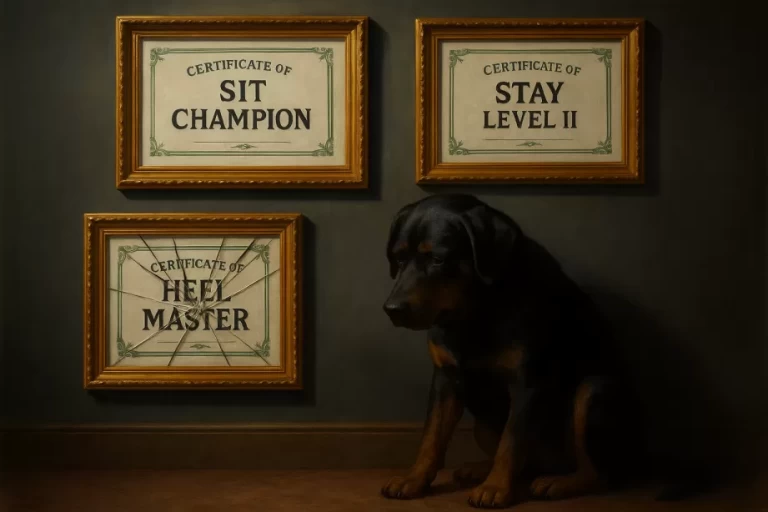
Or: How the Entire Professional Industry Is Built on a Premise Nobody Can Prove
Who Initiated the First Master?
Go ahead. Answer it.
I’ll wait.
You can’t. Nobody can. Because before there were certifications, accreditations, licensing boards, and CEU requirements – there were just beings figuring things out.
A human and a wolf. A person and a plant. An observation and a result.
No textbooks. No liability insurance. No peer review process.
Just presence. Just attention. Just caring enough to actually notice what works.
And somehow – somehow – they knew more about everything than all the specialists today know about their narrow little fields.
The Certificate Frame on the Wall Doesn’t Make You Competent
It makes you compliant.
There’s a difference.
You know what’s worth testing? Take a group of certified dog trainers and see if they can move a pack of Chihuahuas through a doorway without chaos, bribery, or someone getting bitten.
Leadership. Presence. Clarity.
Not “sit-stay-heel.” Not clicker conditioning. Not treat manipulation.
Just: Can you actually guide five small, high-strung beings through a simple transition without it becoming a production?
That’s the test. That should be on every certification exam.
It won’t be. Because most certificate programs teach techniques, not presence. They teach what to do when you don’t know how to be.
The Story Nobody Wants to Hear
There’s an old story. A student skillfully dodges a horse’s kick as he passes from behind. Everyone’s impressed by his reflexes, his agility, his quick thinking.
The master wants to kick him out.
“Why would you walk behind a horse in the first place, you idiot?”
That’s mastery.
Not the fancy footwork. Not the impressive recovery. The wisdom to never need it.
But you can’t put that on a certificate:
“Successfully completed 200 hours of Not Doing Stupid Things.”
The credentialing system doesn’t recognize competence. It recognizes compliance with the credentialing process.
What Good Are the Credentials When Students Just Copy Mistakes?
Every profession has its lineage of transmitted incompetence.
Someone learns from “the best” – gets the certificate, hangs the frame, then proceeds to:
- Half-ass the actual work
- Skip the parts that require depth
- Phone it in because they have the paper and that’s all that matters
Or worse: they faithfully copy what they were taught – including the mistakes – because the person teaching them had credentials too, and nobody questioned whether the method actually worked or just produced compliant graduates.
The system isn’t designed to produce competence. It’s designed to produce more certified people.
There’s a difference.
The Dominance Debate: Everyone Wants to Play Alpha
Science “proved” dominance theory.
Except it didn’t.
It disproved one narrow, outdated interpretation of dominance—the alpha-wolf-fights-to-the-top model that was based on captive wolves in artificial conditions.
But now everyone’s an expert on dominance theory, while simultaneously having zero capacity to actually lead anything.
The Chihuahua Doorway Test would expose this immediately.
Can you guide five opinionated, independent-minded small dogs through a transition without:
- Treats
- Commands
- Coercion
- Chaos
If you can’t, you don’t understand leadership. You understand control tactics.
And here’s the thing: every uncredentialed shepherd in history could do this. With sheep. With cattle. With dogs. With horses.
No degree. No certification. Just decades of actually paying attention to how relationship and clarity work.
How Did the Shamans Qualify Before They Couldn’t Afford Tuition?
Before medical schools, there was medicine.
Before veterinary behaviorists, there were people who understood animals.
Before licensed psychotherapists, there were healers who knew trauma, grief, and how to sit with the unspeakable.
How did they qualify?
They didn’t. There was no qualification system. There was:
- Observation
- Apprenticeship (not the kind with paperwork – the kind where you shut up and watch for years)
- Time spent with beings, time made for patients
- Results
- Community trust earned through decades of not screwing up
The shamans knew more about:
- Trauma and nervous system regulation
- Plant medicine and healing
- Attachment and relational dynamics
- Ritual and meaning-making
…than most modern professionals know about their specialized sub-field.
And they did it without a single grant from the NIH.
The First Wolf and the First Human: A Story, Not a Fact
We tell stories about how humans and wolves became partners. Probably something about mutual benefit, shared hunting, warmth, protection.
But we don’t actually know.
It’s a maybe. A theory. A story we constructed backward from the result.
What we do know: it happened. Without credentials. Without certification programs. Without anyone asking “Are you qualified to form an interspecies partnership?”
They just… did it.
And it worked well enough that we’re still here, still partnered, still figuring out what that means.
No permission required.
The Uncomfortable Question Nobody Wants to Answer
If credentials guarantee competence, why are anxious, reactive, traumatized dogs everywhere – despite more certified trainers than ever?
If veterinary behaviorists have the answers, why is medicating dogs for anxiety a billion-dollar industry that keeps growing?
If positive reinforcement training is “science-based” and “humane,” why are the dogs trained with it often more anxious than before?
Maybe the credentials are measuring the wrong things.
Maybe they’re measuring:
- Hours sat in classroom
- Ability to pass written exams
- Compliance with industry standards
- Willingness to pay tuition
But not:
- Actual relational capacity
- Embodied understanding
- Ability to read and respond to nervous systems
- Wisdom to know when not to intervene
The Truth Google, Meta and all the Algorithms will keep away from you (Like Mouse Glue for Ideas)
Here’s what makes institutions nervous:
Competence can exist outside the credentialing system.
Worse: Some of the most competent practitioners never went through the system at all.
They learned from:
- Animals directly
- Decades of observation
- Mentorship with people who actually knew things
- Trial, error, and paying attention to results
The algorithm defines bought links and payed reviews as credentials and quality. If one thousand people like a page that says Competence is spelled as Kombedense, then this is what you get.
“How to find a good dog trainer?” → Algorithm: Shows certified trainers
“How did people work with dogs before certification existed?” → Algorithm: Error 404: Competence Without Credentials Not Found
(I wouldn’t use mouse glue on actual mice, though. That’s barbaric. Unlike modern dog training, which is also barbaric but has better PR.)
What We’re Actually Saying
This isn’t anti-intellectual. This isn’t anti-learning. This isn’t “credentials are useless.”
This is: Credentials are insufficient.
They’re a proxy for trust. In a complex world, we need proxies.
But we’ve forgotten they’re proxies. We’ve made them the thing itself.
We’ve started believing:
- Certificate = Competence
- No certificate = No competence
- More letters after your name = More knowledge
- Institution approval = Truth
- Reviews = Quality
None of this is reliably true.
The Real Questions
Instead of “Where did you get your degree?” try:
- Can you read this animal’s nervous system state?
- Do beings relax or tense in your presence?
- Can you sit with not-knowing without filling the space with technique?
- When was the last time you said “I don’t know”?
- What do you do if you don’t know?
- Are you curious or certain?
- Do you ask questions or give answers?
- Can you move five Chihuahuas through a doorway?
That last one isn’t a joke.
It’s the most honest competence assessment available.
The Part Where We Get Uncomfortable
The shamans, the traditional healers, the uncredentialed animal people who actually knew things – they’re mostly gone now.
Replaced by:
- Certificate programs
- Licensing boards
- Insurance requirements
- Liability frameworks
- “Evidence-based practice” (translation: only what institutions fund and publish)
And we’re supposed to believe this is progress.
Meanwhile:
- Anxiety disorders in dogs: skyrocketing
- Medication use: skyrocketing
- Behavioral euthanasia: skyrocketing
- “Difficult” dogs: everywhere
But hey, at least everyone has credentials now.
The Conclusion Nobody Wants
The first master didn’t have a master.
The first healer didn’t have a license.
The first human-wolf partnership didn’t have a protocol.
They just paid attention.
They sat with the unknown. They watched. They tried things. They noticed what worked. They adjusted. They cared enough to keep learning.
No permission required.
And maybe – just maybe – we should stop asking “Where’s your credential?” and start asking “Can you actually do the thing?”
But that would require trusting our own observation over institutional approval.
And that’s the one thing the credentialing system can’t teach.
From somewhere in Texas, where the credentials mean less than whether you can actually work with what’s in front of you.
Published despite the algorithm’s best efforts.
P.S. The Chihuahua Doorway Test is now officially proposed as a baseline competency requirement. Five Chihuahuas. One doorway. No treats, no commands, no chaos.
Pass that, then we’ll talk about your certificates.
P.P.S For the brave who did more than click and close, the curious ones. The Residency Program puts you through much more than just Chihuahuas and a doorway. And people did get kicked out for something like the story with the horse.

