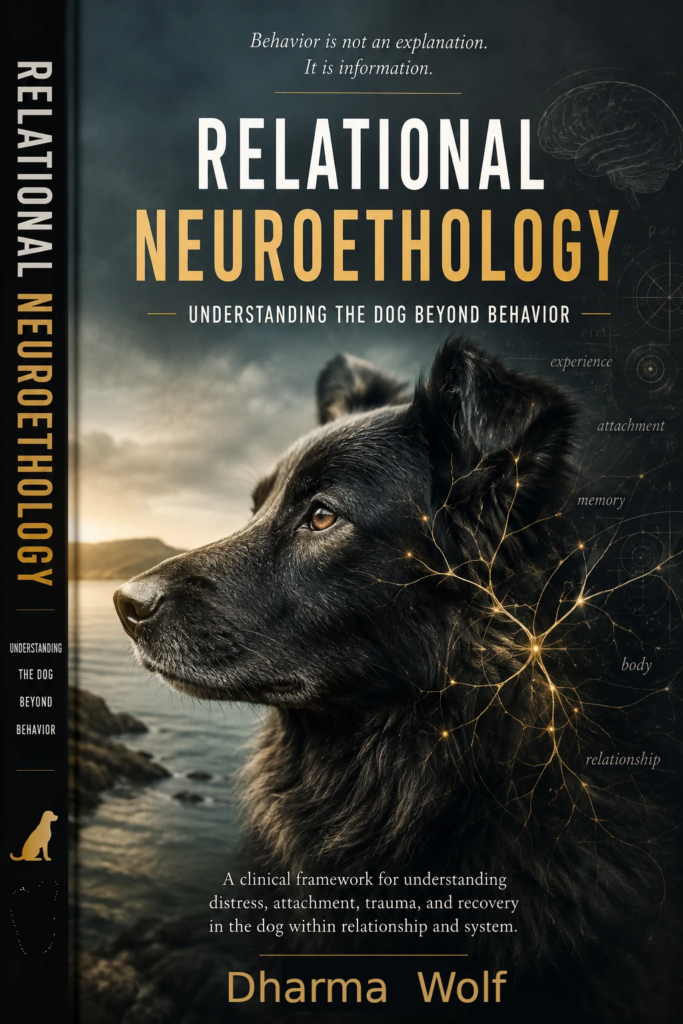
Behavior is not an explanation.
It is information
RELATIONAL
NEUROETHOLOGY
Understanding the dog beyond behavior
A clinical framework for understanding distress, attachment, trauma and recovery in the dog within relationship and system.
Bridging neurobiology, ethology, and relational science help us see dogs not as problems to fix, but as individuals in context.
Inspired by science. Informed by relationship.
A new lens for a deeper understanding
Neurobiology
Explores how the dog brain develops, adapts and responds within relationship and context.
Development
Examines the impact of early experience, stress and safety on lifelong trajectories.
Attachment
Illuminates the power of bonds and the relational origins of regulation and trust.
Trauma & Recovery
Offers a science-based lens on distress and pathways toward healing and resilience.
Relationship
Places the dog within the web of relationships, environments, and systems we share.
This is a landmark work – rigorous, compassionate, and profoundly needed.
– Dr. Karen Overall, DVM, PHD, DACVB.

Relational neuroethology, in its broadest sense, is the intersection of neuroscience, behavioral biology (ethology), and relationship research. It investigates how social relationships and interactions affect the neurological and physiological development of individuals. Animals are living beings deserving of kindness, respect, and care.