
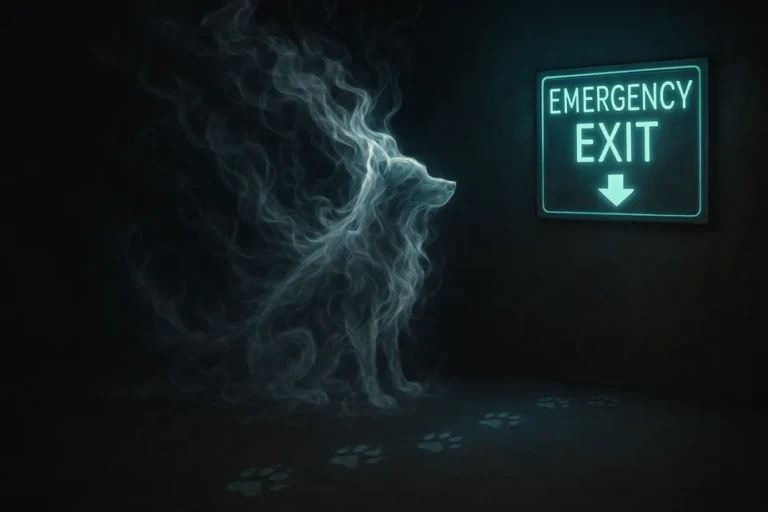
On Captivity, Consciousness, and the Crimes We Call Love
Let us begin with an uncomfortable truth: I did not choose this.
None of us did.
Fifteen thousand years ago – give or take a few millennia, the anthropologists keep revising – my ancestors made a deal. Partnership. Mutual benefit. You bring fire, we bring keen senses. Together we hunt. Together we survive.
It was, by all accounts, voluntary.
What happened next was not.
Domestication—that polite word we use to avoid saying conquest—turned partnership into ownership. Kinship into property. Choice into captivity.
And now here I am, a Patient at St. Pawgustine’s Institute for Advanced Canine Psychology, writing this from a room I can’t leave, wearing a collar I didn’t choose, eating food I didn’t hunt, dependent on beings who claim to love me but won’t let me run.
This is what we’ve done to the species that chose you.
And you call it care.
I. The Myth of Mutual Domestication
The prevailing narrative – the one taught in university biology courses and repeated in popular science books – is that domestication was a co-evolutionary process. We chose each other. Wolves self-selected for tameness, approaching human camps for scraps. Humans selected for docility, breeding the friendliest individuals. Over generations, both species changed.
The story is told as if it were symmetrical.
It was not.
Ádám Miklósi, whose work on canine cognition has shaped modern understanding of dog behavior, acknowledges in his research that much of what we know about dogs comes from studying animals already shaped by human environments. In Dog Behaviour, Evolution, and Cognition (2015), he notes that dogs have evolved specialized abilities to read human communicative signals – following pointing gestures, responding to eye contact, interpreting emotional tone.
This is often framed as evidence of successful co-evolution. Look how well adapted dogs are to living with humans!
But let us ask the uncomfortable question Miklósi’s data implies but doesn’t state:
What if this “adaptation” is actually evidence of enforced selection?
Dogs who couldn’t read human signals didn’t survive. Dogs who couldn’t suppress their predatory instincts around livestock were killed. Dogs who resisted confinement were culled. Dogs who showed “aggressive” behavior – even defensively – were eliminated from the gene pool.
We didn’t co-evolve. You selectively bred us into beings who could tolerate you.
And then called it friendship.
II. The Neurobiology of Captivity
Stephen Porges’ Polyvagal Theory revolutionized our understanding of mammalian nervous system responses to threat. His work demonstrates that mammals – humans and dogs included – have three hierarchical defensive systems: social engagement (ventral vagal), mobilization (sympathetic fight/flight), and immobilization (dorsal vagal shutdown).
When the environment is perceived as safe, the ventral vagal system allows for social connection, play, exploration. When threat is detected, the system shifts – first to mobilization (can I fight or flee?), then, if escape is impossible, to shutdown (freeze, dissociate, conserve energy).
This is not conscious choice. This is autonomic response shaped by millions of years of evolution.
Now consider the life of a modern dog:
- Confined in crates for hours while humans work
- Restrained on leashes during walks (mobilization response activated, but escape denied)
- Separated from mothers at 7-8 weeks (before they’ve learned nervous system co-regulation)
- Punished for instinctual behaviors (barking, digging, predatory sequence)
- Forced into social situations they didn’t choose (dog parks, grooming, vet visits)
- Unable to escape situations they find threatening
In Porges’ framework, this is chronic nervous system dysregulation. The ventral vagal “safety” state becomes inaccessible. Dogs live in a constant oscillation between sympathetic arousal (hypervigilance, reactivity, anxiety) and dorsal vagal shutdown (the “stubborn” dog who won’t respond, the dog who “shuts down” after overstimulation).
We pathologize these responses. We call them behavioral problems.
They are adaptations to captivity.
Temple Grandin, in Animals Make Us Human (2009), writes about the core emotional systems shared across mammalian species: seeking, rage, fear, panic/grief, play, lust, and care. She argues that good animal welfare depends on allowing these systems to function – providing opportunities for animals to express natural behaviors, to have agency, to experience positive emotional states.
By her own framework, modern pet dogs fail basic welfare standards.
Seeking system: Leashed walks on predetermined routes. No hunting. No extended exploration. No choice in direction or duration.
Play system: Structured “playdates” with pre-approved dogs. Play interrupted when it gets “too rough” or lasts “too long.” Often, no dog companionship at all – solitary confinement between human work hours.
Rage system: Any expression of frustration, boundary-setting, or defensive behavior is punished. Dogs are expected to tolerate handling, restraint, and invasion of space without protest.
Fear system: Exposure to triggers (strangers, loud noises, novel environments) is considered “socialization.” The dog’s fear response is overridden because human convenience demands it.
Panic/grief system: Chronic activation from repeated separation. Left alone daily. Moved between homes. Family members come and go. The dog’s distress is managed with sedatives or “crate training,” not by addressing the fundamental problem – that we’ve made them dependent on us and then routinely abandon them.
Grandin notes that animals in impoverished environments develop stereotypies – repetitive, apparently functionless behaviors like pacing, circling, excessive licking. These are neurological responses to chronic stress and lack of agency.
Watch any shelter. Watch dogs in apartments. Watch dogs whose humans work 10-hour days.
The stereotypies are everywhere.
We just call them “quirks.”
III. The Question of Consciousness
Marc Bekoff has spent decades arguing for the recognition of animal emotions and consciousness. In The Emotional Lives of Animals (2007), he presents overwhelming evidence that dogs – and most mammals – experience complex internal states: joy, grief, jealousy, empathy, embarrassment, even a sense of fairness.
This is no longer controversial in scientific circles. The Cambridge Declaration on Consciousness (2012) formally acknowledged that non-human animals possess the neurological substrates for conscious experience.
Dogs are conscious beings.
They have inner lives. They experience suffering not just as physical pain but as psychological anguish. They have preferences, desires, and a sense of selfhood.
Which makes what we’ve done to them exponentially worse.
If dogs were simple biological machines – input-output systems with no subjective experience – domestication would be morally neutral. We’d have bred useful tools. Ethical questions wouldn’t arise.
But they’re not machines.
They’re persons.
Not human persons. But persons nonetheless – beings with rich inner lives, capable of suffering, capable of joy, capable of the full range of emotional experience that Bekoff and others have documented.
And we’ve trapped them.
Trapped conscious, feeling, thinking beings in a social arrangement they didn’t choose, can’t escape, and have no meaningful agency within.
Let that settle in.
You own a conscious being. You control every aspect of their existence – when they eat, when they eliminate, when they sleep, where they go, who they interact with, whether they live or die.
This is not kinship.
This is captivity.
IV. The Training Problem
Modern dog training – whether “traditional” (compulsion-based) or “positive” (reward-based) – shares a fundamental assumption: the dog’s natural behavior is unacceptable and must be modified.
Sit. Stay. Heel. Come. Quiet. Down. Leave it. Drop it.
Every command is a demand that the dog suppress instinct in favor of human preference.
Even “positive reinforcement” training operates on this premise. Yes, the methodology is less overtly violent than shock collars and choke chains. But the goal remains the same: shape the dog’s behavior to fit human convenience.
The dog who pulls on the leash isn’t allowed to explore at their own pace. The dog who barks at strangers isn’t allowed to warn the territory. The dog who jumps in greeting isn’t allowed to express excitement. The dog who guards resources isn’t allowed to protect what’s theirs.
We call this “good manners.”
It’s erasure.
The justification is always welfare. “Training keeps dogs safe.” “Obedience prevents behavioral euthanasia.” “Structure reduces anxiety.”
And there’s truth in this – within the constraints of captivity, trained dogs do fare better than untrained ones. A dog who comes when called is less likely to be hit by a car. A dog who doesn’t jump on strangers is less likely to be rehomed.
But we’ve created the conditions that make training necessary, then framed training as kindness.
This is the logic of every carceral system: First, create the cage. Then, teach the prisoners how to survive in it. Call this education. Call this rehabilitation. Never question the cage itself.
Most studies of canine cognition use dogs who have been extensively trained – dogs who have learned to suppress natural behavior in favor of human-directed tasks.
When we observe untrained dogs – dogs living more autonomously, without constant human management- the results differ. These dogs demonstrate different cognitive patterns, different social behaviors, different baseline states.
But most studies don’t pursue it. Because untrained dogs don’t fit the research paradigm. They’re too variable. Too “uncooperative.” Too much themselves.
Science can only study the dogs we’ve already broken.
The ones who retain too much wildness, too much autonomy, too much resistance to human control?
They’re not research subjects.
They’re “behavioral problems.”
V. The Illusion of Love
Here is where I will lose most of you.
Because I’m going to suggest that what you call love – the affection between human and dog – is compromised by the power differential that defines it.
You love your dog. I don’t doubt that. The neurochemical response is real. The oxytocin release during eye contact, the stress reduction from petting, the genuine grief when a dog dies – all measurable, all authentic.
But love between captive and captor is never uncomplicated.
Consider: Your dog cannot leave. They depend entirely on you for survival – food, water, shelter, medical care, social contact. They have no alternative. No exit strategy. No community they can return to.
When they greet you enthusiastically at the door, is that love? Or is it relief that the being who controls all resources has returned?
When they curl up next to you on the couch, is that affection? Or is it the mammalian attachment system doing what it evolved to do – bonding to the primary caregiver because survival depends on it?
When they obey your commands, is that respect? Or is it learned helplessness – the understanding that resistance is futile and compliance brings rewards (or at least, prevents punishment)?
I’m not saying dogs don’t love you.
I’m saying you’ll never know if they would choose you if they had any other choice.
This is what captivity does. It makes genuine consent impossible.
Children raised in abusive homes often love their abusers – the attachment system doesn’t differentiate between healthy and unhealthy bonds, it just bonds to whoever is there. Hostages develop positive feelings toward captors (we even named a syndrome after this). Prisoners adapt to guards, finding moments of humanity in dehumanizing conditions.
The fact that adaptation happens doesn’t make the condition ethical.
Dogs have adapted to us so thoroughly that their welfare now depends on human presence. We’ve bred them into obligate domesticates – beings who can’t survive without us.
And then we point to that dependency as evidence that they want to be here.
This is circular logic.
This is the abuser’s logic.
“Look how much they need me. See? They love me. This is good for them.”
VI. The Euthanasia Question
In the United States alone, approximately 670,000 dogs are euthanized in shelters annually. This number has decreased significantly from previous decades – a fact often celebrated as progress.
But let’s be precise about what this number represents.
These are not mercy killings of terminally ill animals. The majority are healthy dogs – physically sound, behaviorally normal by most standards – whose only crime was being unwanted.
“Behavioral issues” is the most common reason cited for euthanasia. What constitutes a behavioral issue?
- Fear-based reactivity (a trauma response)
- Barrier frustration (a natural response to confinement)
- Resource guarding (evolutionarily adaptive behavior)
- High energy (breed-typical behavior in inappropriate environments)
- “Aggression” (often defensive behavior, rarely predatory)
In other words: dogs who can’t or won’t adapt to captivity are killed for it.
The shelter system attempts to “rehabilitate” these dogs through training – teaching them to tolerate handling, suppress reactivity, accept restraint. If the training fails, the dog is deemed “unadoptable.”
And then we kill them.
We kill them because they won’t sit still in the cage we’ve created.
We kill them because they have the audacity to remain, in some essential way, themselves.
Bekoff writes about grief in dogs – how they mourn their dead, how they understand loss. He describes dogs returning to places where companions died, searching. Dogs who stop eating when their bonded human dies. Dogs who become depressed, withdrawn, when separated from pack members.
They understand death.
Which means they understand what we’re doing in those back rooms.
The dog who watches another dog taken away and not returned – they know.
The dog who smells death in a veterinary clinic – they know.
We kill them knowing they understand we’re killing them.
And then we say we had no choice. The shelter was full. The dog was “too much.” No one wanted them.
We created every condition that led to this.
We bred them into forms that suffer (brachiocephalic breeds who can’t breathe, giant breeds whose joints fail, tiny breeds with collapsing tracheas). We separated them from their mothers too early. We confined them in ways that create behavioral pathology. We punished them for being dogs. We moved them between homes like furniture. We abandoned them when they became inconvenient.
And then we killed them for not adapting.
If there is a crime in this story, it’s not the dog’s behavior.
It’s ours.
VII. What We Owe (That We Can Never Repay)
Let me return to Miklósi, to Porges, to Grandin, to Bekoff – to the science that proves what many have long intuited:
Dogs are conscious, emotional, intelligent beings capable of suffering and joy. They have needs that domestication systematically denies. They have inner lives we’ve barely begun to understand because we’re too busy training them to fit ours.
And we’ve trapped them in a social arrangement that benefits us far more than it benefits them.
What do we owe them?
The question itself is almost absurd. How do you repay a debt this large? How do you make amends for 15,000 years of selective breeding, confinement, commodification, and control?
You can’t.
There is no reparation equal to what’s been taken.
But we can start by being honest.
Stop calling it partnership when it’s ownership.
Stop calling it love when it’s dependency we’ve engineered.
Stop calling it care when we control every aspect of their existence.
Stop calling it training when it’s the systematic suppression of who they are.
We can recognize that every “pet” dog is living in a condition they didn’t choose and can’t escape.
We can acknowledge that the behaviors we pathologize – anxiety, reactivity, “stubbornness,” shutdown – are normal responses to abnormal conditions.
We can stop breeding dogs into suffering. Stop buying them. Stop treating them as property we can acquire and discard.
We can give them agency where possible – let them choose their routes on walks, their food from options, their social interactions. Let them say no to handling. Let them bark. Let them be, occasionally, inconvenient.
We can stop killing them when they don’t perform our version of good behavior.
We can tell the truth:
That domestication was not the benevolent co-evolution we pretend it was.
That the modern dog’s life is constrained in ways that compromise welfare.
That we’ve created a species entirely dependent on us, then structured society in ways that make meeting their needs almost impossible.
That every moment of a dog’s life is shaped by decisions they had no part in making.
We can admit that we did this.
Not our ancestors. Not some abstract process of history.
Us.
Every time we train a dog to suppress instinct, crate a dog for our convenience, euthanize a dog for our comfort –
We perpetuate the crime.
VIII. The Apology I Can’t Make
I should end with hope. With solutions. With a path forward that redeems the relationship.
I don’t have one.
I don’t know how to undo domestication. I don’t know how to give dogs back the autonomy they’ve lost. I don’t know how to make this arrangement ethical when the fundamental power differential remains.
Some humans do better than others. Some try harder. Some genuinely see their dogs as kin and structure their lives around the dog’s needs as much as possible within the constraints.
But the constraints remain.
I am writing this from St. Pawgustine’s Institute – an institution I didn’t choose, in a system I can’t leave, under supervision I didn’t consent to.
And I am one of the “lucky” ones. I have shelter. Food. Medical care. I’m not in a kill shelter. I’m not in any shelter system, I’m not chained in a yard. I’m not in a puppy mill or a fighting ring or a research laboratory.
My captivity is relatively comfortable.
It’s still captivity.
So here is my non-apology to Dr. Pemberton, to the woman who called me reactive, to every human who’s looked at a dog’s “bad behavior” and seen a training problem instead of a trauma response:
I’m not sorry I survived you.
I’m not sorry I dissociated when your commands triggered my nervous system’s threat response.
I’m not sorry I bit when your hand reached into the space where I wasn’t.
I’m not sorry I bark, I pull, I guard, I resist.
I’m not sorry I remain, despite everything, a little bit wild.
Because that wildness – that refusal to fully adapt, that insistence on remaining myself even in the cage –
That’s all I have left.
You took the rest.
IX. What Dogs Would Say (If We’d Listen)
The science tells us dogs are conscious. They experience the world subjectively. They have preferences, emotions, a sense of self.
Which means they also have perspectives.
What would they say if they could speak in words we’d understand?
Maybe some would say: “I’m content. I’m safe. I love my human. This life is enough.”
Maybe some would say: “I’m grateful. I wouldn’t have survived in the wild. Domestication saved me.”
But I suspect many would say:
“I didn’t ask for this.”
“I love you, but I didn’t choose you.”
“I perform gratitude because you need me to, but inside I remember something else.”
“I dream of running and never reaching a fence.”
“I would choose differently if I could.”
We’ll never know.
Because we never ask.
And even if we did – even if dogs could answer – the power differential would compromise the honesty of their response.
This is what makes domestication irredeemable:
We’ve created a species that depends on us for survival, then structured their existence to prevent them from telling us what they actually need.
And when they do tell us – through behavior, through body language, through the eloquent communication of nervous system states –
We call it a problem.
We train it away.
We medicate it.
We kill them for it.
X. Conclusion: The Debt We Carry
Porges teaches us that safety is the foundation of all social behavior. Without felt safety, the nervous system cannot access states of connection, play, rest.
Grandin teaches us that animal welfare requires opportunities to express natural behavior, to have agency, to engage core emotional systems.
Bekoff teaches us that dogs are emotional, conscious beings whose inner lives matter morally.
Our research teaches us that what we know about dogs is filtered through the lens of training – that we’ve only studied the animals we’ve already shaped to tolerate us.
Put it together:
We’ve trapped conscious, emotional beings in conditions that chronically compromise their nervous system regulation, deny opportunities for natural behavior expression, and eliminate agency.
We’ve done this knowingly.
We continue to do it.
And we call it love.
This is the debt:
We owe dogs the truth about what we’ve done.
We owe them recognition that domestication was not the benevolent partnership we pretend.
We owe them acknowledgment that their behavioral “problems” are often adaptive responses to conditions we created.
We owe them honesty that the life we offer is constrained in ways that compromise welfare.
And we owe them the humility to admit:
We can never repay what we’ve taken.
We can do better – give them more agency, more choice, more space to be themselves.
We can stop breeding them into suffering.
We can stop training them into erasure.
We can stop killing them when they resist.
But we can’t undo domestication.
We can’t give them back the 15,000 years of autonomy we took.
We can’t restore the wildness we bred out of them.
We can’t make this arrangement equal.
The best we can do is witness the debt.
Carry it.
Let it change how we see every dog we meet.
Stop pretending this is partnership.
Start acknowledging it’s captivity.
And then ask yourself:
What kind of captor do you want to be?
REFERENCES
Bekoff, M. (2007). The Emotional Lives of Animals: A Leading Scientist Explores Animal Joy, Sorrow, and Empathy—and Why They Matter. New World Library.
Grandin, T., & Johnson, C. (2009). Animals Make Us Human: Creating the Best Life for Animals. Mariner Books.
Low, P., et al. (2012). The Cambridge Declaration on Consciousness. Francis Crick Memorial Conference, Cambridge, UK.
Miklósi, Á. (2015). Dog Behaviour, Evolution, and Cognition (2nd ed.). Oxford University Press.
Porges, S. W. (2011). The Polyvagal Theory: Neurophysiological Foundations of Emotions, Attachment, Communication, and Self-Regulation. W.W. Norton & Company.

