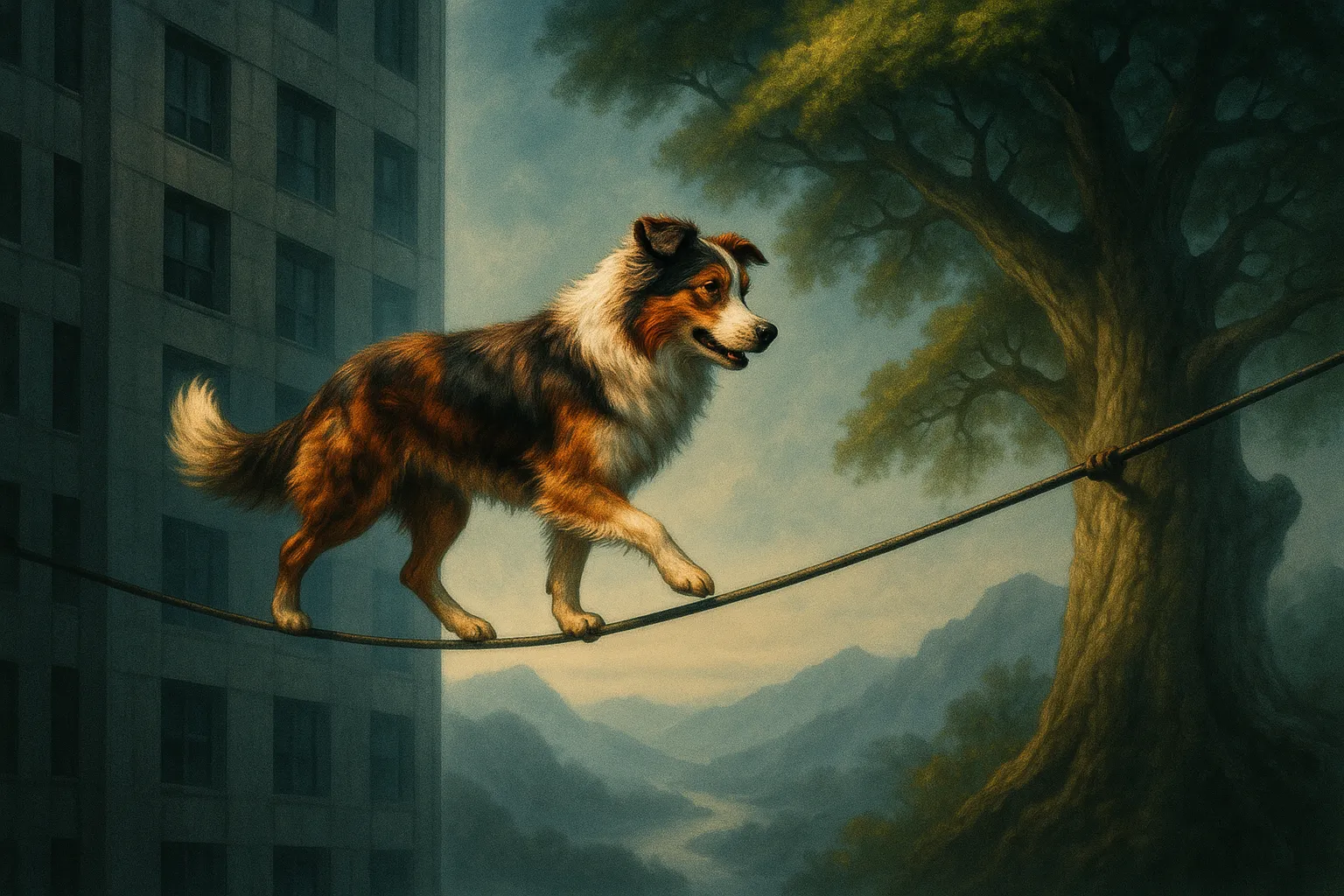

Sensory Processing Sensitivity Across Species
TAO Animal Center Research Dept.
Abstract
Approximately 15-20% of dogs (and humans) demonstrate heightened sensory processing sensitivity – detecting environmental stimuli others miss, processing information more deeply, and showing stronger emotional responses. Rather than pathology, this represents an evolutionary strategy: populations benefit from having sensitive individuals who detect threats, changes, and subtleties that others overlook. However, modern environments – with constant stimulation, unpredictability, and sensory assault – are particularly hostile to sensitive nervous systems. Dogs labeled “reactive,” “fearful,” “anxious,” or “neurotic” are often highly sensitive individuals in overwhelming conditions. This paper explores sensory processing sensitivity across species, distinguishes it from anxiety disorders and trauma, and provides frameworks for supporting rather than suppressing sensitive dogs.
Keywords: sensory processing sensitivity, highly sensitive dog, reactivity, environmental overwhelm, sensory processing, HSP, canine temperament
Introduction: The Dog Who Feels Too Much
A common scenario:
Dog lunges at other dogs on walks. Barks at sounds others don’t notice. Startles easily. Won’t settle in busy environments. Needs “decompression time” after outings.
Standard labels:
- “Reactive”
- “Fearful”
- “Anxious”
- “Needs more socialization”
- “Poorly trained”
Standard treatment:
- Desensitization (more exposure)
- Counter-conditioning
- Medication
- “Just needs to relax”
Result: Often worse. Why?
Because this isn’t a disorder. This is a highly sensitive nervous system accurately detecting overwhelm.
What is Sensory Processing Sensitivity?
The Research Foundation
Dr. Elaine Aron’s groundbreaking work (1990s):
Identified trait in humans called Sensory Processing Sensitivity (SPS) or Highly Sensitive Person (HSP):
Characteristics:
- Depth of processing (analyze deeply before acting)
- Overstimulation (overwhelmed by high-stimulation environments)
- Emotional reactivity (strong emotional responses)
- Sensory sensitivity (detect subtle stimuli)
Key finding: This isn’t pathology. This is temperament variation found across species.
Prevalence: 15-20% of humans (and many animal species studied)
Evolutionary advantage: Populations benefit from mix of:
- Bold, exploratory individuals (pioneers, risk-takers)
- Sensitive, cautious individuals (threat detectors, careful observers)
Both strategies succeed. Neither is broken.
The Canine Parallel
Research demonstrates similar traits in dogs (Ákos et al., 2014; Svartberg, 2005):
Bold vs. Sensitive temperament spectrum:
Bold dogs (80-85%):
- Approach novel stimuli quickly
- Explore without hesitation
- Less affected by environmental changes
- Recover quickly from startles
- “Thick-skinned”
Sensitive dogs (15-20%):
- Observe before approaching
- Process deeply before acting
- Highly affected by environmental changes
- Longer recovery from startles
- “Thin-skinned”
Neither is better or worse. Both are adaptive strategies.
The problem: We built a world for bold dogs. And we pathologize sensitive ones.
Identifying the Highly Sensitive Dog
Core Characteristics
1. Sensory Acuity (They Detect What You Don’t)
Highly sensitive dogs notice:
- Sounds you can’t hear (electrical hum, appliance frequencies, distant noises)
- Smells you don’t register (cleaning products, someone who visited yesterday, emotion changes in humans)
- Visual subtleties (shadows moving, flickering lights, tiny environmental changes)
- Vibrations (trucks blocks away, someone approaching before visible)
- Barometric pressure changes (storms coming, weather shifts)
This isn’t “overreacting.” This is accurate detection of stimuli others filter out.
Example:
Dog barks at “nothing.”
Owner sees: Empty hallway, no threat.
Dog detects: Neighbor in adjacent apartment moving furniture. Sound frequency and vibration humans don’t consciously register.
The dog isn’t imagining threats. The dog is detecting real stimuli.
2. Deep Processing (They Think Before Acting)
Highly sensitive dogs:
- Pause and observe new situations
- Don’t rush into interactions
- Appear “cautious” or “timid”
- Actually: Processing information before committing
Comparison:
Bold dog meets new dog:
- Immediate approach
- Quick greeting
- Move on
Sensitive dog meets new dog:
- Observe from distance
- Assess body language, energy, threat level
- Slow, careful approach if feels safe
- May decline interaction if assessment = “not safe”
Bold approach labeled “confident.” Sensitive approach labeled “fearful.”
Actually: Two different information-processing strategies. Both valid.
3. Emotional Depth (They Feel Intensely)
Highly sensitive dogs:
- Strong emotional responses (joy, fear, sadness)
- Pick up on human emotions (absorb household stress)
- Take time to recover from emotional events
- Form deep bonds (but selectively)
This isn’t “unstable.” This is emotional depth and empathy.
Example:
Household argument between humans.
Bold dog: Might notice briefly, returns to normal quickly.
Sensitive dog: Distressed during conflict, continues showing stress signs (panting, pacing) hours after, may hide.
Not “anxious.” Emotionally attuned and affected.
4. Environmental Overwhelm (They Have Limits)
Highly sensitive dogs have lower thresholds for:
- Stimulation intensity (loud = overwhelming)
- Stimulation duration (busy environment tolerable briefly, exhausting long-term)
- Multiple simultaneous stimuli (sounds + smells + visual + social = overload)
- Unpredictability (changes are harder to process)
This isn’t weakness. This is nervous system operating with different parameters.
The cup analogy:
Everyone has a cup that fills with stimulation.
Bold dogs: Large cup, takes a lot to overflow.
Sensitive dogs: Smaller cup, fills faster.
Overflow = reactive behavior, shutdown, stress responses.
Neither cup size is wrong. They’re just different.
Sensitive ≠ Anxious ≠ Traumatized
Critical Distinctions
These often get confused. They’re different:
Highly Sensitive Dog (Temperament)
Core trait:
- Born this way (genetic/developmental)
- Consistent across life (doesn’t suddenly appear)
- Present in safe, predictable environments
- Processes all stimuli deeply (not just threatening ones)
Presentation:
- Observes before acting
- Easily overwhelmed by high-stimulation
- Strong emotional responses
- Detects subtle environmental changes
Needs:
- Appropriate environment (lower stimulation, predictable)
- Respect for processing speed
- Gentle handling
- Understanding this is temperament, not problem
Intervention:
- Environmental accommodation
- Respect limits
- Build confidence through success
- Accept this is who they are
Anxious Dog (Generalized Anxiety)
Core trait:
- Excessive worry across contexts
- May develop any time (not necessarily lifelong)
- Present even in genuinely safe situations
- Anticipates threat constantly
Presentation:
- Hypervigilance without specific trigger
- Difficulty relaxing anywhere
- Physiological stress signs (panting, drooling, GI issues)
- Generalized fear
Needs:
- Veterinary assessment (medical causes?)
- Possible medication (if severe)
- Anxiety management protocols
- Environmental stability
Intervention:
- May need behavioral medication
- Counter-conditioning anxiety responses
- Building sense of safety
- Possibly permanent management
Traumatized Dog (Past Experience)
Core trait:
- Specific trigger related to past trauma
- Appeared after traumatic event
- Triggered by reminders of trauma
- Otherwise may be fine
Presentation:
- Intense fear of specific stimuli
- May generalize to similar stimuli
- Trauma-processing behaviors
- Memory-based response
Needs:
- Trauma-informed care (see trauma paper)
- Processing time
- Safety from trigger
- Respect for trauma memory
Intervention:
- Avoid re-traumatization
- Gradual exposure (if appropriate, dog-paced)
- May take months to years
- Some triggers may always be difficult
The Overlap Problem
A dog can be:
- Highly sensitive AND anxious
- Highly sensitive AND traumatized
- Traumatized AND now anxious
- All three
But the interventions differ:
Sensitive dog: Needs environmental accommodation, not desensitization
Anxious dog: Benefits from trauma-informed care + management
Traumatized dog: Needs trauma processing, not exposure
Example:
Dog is highly sensitive (temperament) + experienced trauma (board-and-train with shock collar) + now generalized anxiety (learned world is unsafe).
Treatment must address all three:
- Accommodate sensitivity (lower stimulation environments)
- Process trauma (specific to training experience)
- Manage anxiety (possibly medication, definitely environmental safety)
If you only treat as “anxiety” or only as “trauma,” you miss the sensitivity component – and accommodation won’t happen.
Why Modern Life is Hostile to Sensitive Dogs
The Sensory Assault Environment
Modern environments provide constant:
Auditory overwhelm:
- Traffic (constant background rumble)
- Sirens (unpredictable, high-intensity)
- Appliances (refrigerators, HVAC, electronics – constant hum)
- Neighbors (voices, TVs, music through walls)
- Leaf blowers, lawn equipment (intense, unpredictable)
- Fireworks (depending on location, frequent)
Visual overwhelm:
- Fluorescent lighting (flickers 120x per second – some dogs detect this)
- Screen flicker (TVs, computers)
- High activity (busy streets, pedestrians, dogs)
- Reflections, shadows (movement triggers)
Olfactory overwhelm:
- Cleaning products
- Air fresheners
- Perfumes, detergents
- Garbage, urban smells
- Other animals (neighbors’ pets, birds, etc.)
Social overwhelm:
- High dog density (urban areas)
- Forced proximity (apartment buildings, sidewalks)
- Unpredictable interactions
- Other dogs’ stress signals
For sensitive dogs: This is CONSTANT ASSAULT. Like living in a night club 24/7 for someone with sensory processing sensitivity.
The Unpredictability Problem
Sensitive nervous systems need predictability to feel safe.
Modern life provides:
- Irregular schedules (owners’ work varies)
- Unpredictable visitors
- Random construction, sirens, events
- Neighbor behaviors (when will leaf blower happen?)
- Weather extremes
- No control over environment
For sensitive dogs: Can never fully relax. Constant threat-scanning.
The “Socialization” Demand
Modern dog culture expects:
- All dogs should love dog parks
- All dogs should greet other dogs
- All dogs should be “friendly”
- Sociability = good, selectivity = problem
For sensitive dogs:
Dog parks = sensory hell:
- Too many dogs
- Too much stimulation
- Unpredictable interactions
- No escape
- No control
Forced socialization doesn’t build confidence. It creates overwhelm.
Sensitive dogs often prefer:
- One or two dog friends (selected, compatible)
- Parallel activities (walking near, not playing with)
- Human company over dog company
- Or solitude
This isn’t “poorly socialized.” This is temperament.
Case Studies: Sensitive Dogs Misunderstood
Case 1: The “Reactive” Leash Walker
Presentation:
- 3-year-old Border Collie mix
- Lunges and barks at other dogs on leash
- Fine with dogs off-leash at distance
- Described as “leash reactive,” “aggressive”
Standard interpretation: Barrier frustration, needs desensitization to other dogs.
Actual assessment:
- Dog is highly sensitive
- Leash = can’t control distance (threat)
- Other dogs approaching on narrow sidewalk = forced proximity = overwhelm
- Barking/lunging = “I need space!” (self-protection)
- Off-leash at distance = can control proximity = comfortable
The “reactivity” is space management, not aggression.
Standard approach (failed):
- 6 months desensitization (forced proximity to dogs)
- Counter-conditioning (treats when dogs present)
- “Focus” exercises (ignore the overwhelming stimulus)
- Result: Worse. Dog now reactive at greater distances.
Why it failed: Forced the dog into overwhelm repeatedly. Increased sensitivity to trigger.
Sensitive-dog approach:
Phase 1: Respect the need for space
- Walk routes with space (quiet streets, wide sidewalks, parks)
- Avoid forced proximity
- Allow dog to observe from chosen distance
- No forced greetings
Phase 2: Control over distance
- Dog chooses approach or avoidance
- Handler respects choice
- Increase distance if dog uncomfortable
- Decrease distance only if dog chooses
Phase 3: Acceptance
- Dog may never be “dog park social”
- That’s okay
- Goal: Comfortable walks with manageable distance, not forced friendliness
Outcome:
- After 3 months: Dog relaxed on walks in appropriate environments
- Still prefers distance from unfamiliar dogs (respected)
- No longer “reactive” because space needs are met
- Happy, confident within appropriate parameters
Key insight: The dog didn’t need desensitization. The dog needed environmental accommodation.
Case 2: The “Nervous” Rescue
Presentation:
- 2-year-old mixed breed, shelter adoption
- Startles at sounds
- Won’t approach new people
- Hides when visitors come
- Shelter history: Unknown, labeled “needs confidence building”
Standard interpretation: Poorly socialized, needs exposure to build confidence.
Actual assessment:
- Highly sensitive temperament
- No trauma (careful assessment confirmed)
- Not anxious (comfortable in quiet, predictable home)
- Just… sensitive
Standard approach (attempted by adopter before St. Pawgustine’s):
- Force visitors to give treats
- Bring dog to busy places for “exposure”
- “Can’t let her hide – she’ll never improve”
- Result: Dog shut down completely, stopped eating
Why it failed: Flooding a sensitive dog creates overwhelm, not confidence.
Sensitive-dog approach:
Phase 1: Acknowledge temperament
- This dog will always be cautious
- That’s not a problem to fix
- That’s a temperament to respect
Phase 2: Create optimal environment
- Quiet home (not busy, not chaotic)
- Predictable routine
- Safe hiding spaces (allowed to retreat)
- Minimal visitors (adopter is introverted anyway – perfect match)
Phase 3: Choice-based confidence building
- Visitors do not touch dog unless dog initiates
- Dog approaches if/when ready (not forced)
- Hiding is permitted (safety, not avoidance problem)
- Success = dog making choices, not dog forced into interactions
Outcome:
- After 6 months: Dog comfortable in home, bonds deeply with adopter
- Still cautious with strangers (that’s fine)
- Happy, healthy, thriving
- Perfect for adopter’s quiet lifestyle
Key insight: Dog didn’t need fixing. Dog needed right environment and acceptance.
Case 3: Princess Pawdrey
Presentation:
- 4-year-old mix, St. Pawgustine’s patient
- “Personality changes” with different contexts
- One moment playful, next moment shut down
- Diagnosed with “Multiple Coats Disorder” (St. Pawgustine’s humor, but meaningful)
What observers saw:
- At quiet park: Confident, playful, exploratory
- At dog park: Shut down, hiding behind handler
- At home: Affectionate, engaged
- With visitors: Withdrawn, distant
- After busy day: Couldn’t settle for hours
Standard interpretation: Inconsistent, unstable, needs behavioral medication.
Dr. Mera Cata’s assessment: “This dog isn’t unstable. This dog is accurately reading and responding to environmental complexity.”
The pattern:
- Low-stimulation environments: Confident
- High-stimulation environments: Overwhelmed
- Predictable contexts: Relaxed
- Unpredictable contexts: Cautious
This is highly sensitive dog demonstrating context-appropriate responses.
Multiple Coats Disorder = Sophisticated environmental assessment and adaptive responding.
Intervention:
- Acknowledge: Dog’s responses are accurate to context
- Optimize: Provide low-stimulation environments most of time
- Accept: “Inconsistency” is actually consistency (consistently responsive to environment)
- Respect: Dog’s feedback about environment quality
Princess Pawdrey’s wisdom: “They call it Multiple Coats Disorder. I call it reading the room. Maybe if everyone read the room, we’d build better rooms.”
Outcome: Dog thriving in environments matched to sensitivity, struggling in environments hostile to it. Problem isn’t dog. Problem is environments.
Supporting Highly Sensitive Dogs
Environmental Optimization
1. Reduce Sensory Input
Auditory:
- White noise machines (mask unpredictable sounds)
- Quiet residential areas (avoid busy streets)
- Limit high-intensity sounds (vacuum when dog elsewhere, warn before blender)
- Soundproofing when possible
Visual:
- Natural lighting (not fluorescent)
- Minimize screen use when dog present
- Window coverings (control visual stimulation)
- Calm, uncluttered spaces
Olfactory:
- Unscented cleaning products
- No air fresheners, plug-ins
- Minimize perfumes
- Respect dog’s olfactory world
2. Increase Predictability
Routines:
- Consistent feeding times
- Predictable walk schedule
- Regular sleep/wake times
- Advance warning of changes
Spaces:
- Dedicated safe spaces (never violated)
- Consistent furniture arrangement
- Dog knows where things/people will be
Social:
- Predictable visitors (or warn in advance)
- Consistent household members
- Clear cues for “someone’s coming”
3. Respect Processing Speed
Don’t rush:
- Let dog observe before engaging
- Allow “thinking time” before expecting response
- Don’t force immediate interaction with novelty
- Slow introductions to anything new
Example:
- New toy: Leave it out, let dog investigate when ready (don’t force interaction)
- New person: Let person exist in space, dog approaches when/if ready
- New place: Allow extended observation time before expecting dog to explore
4. Provide Control
Choices:
- Can dog choose to approach or avoid?
- Can dog choose distance from stimuli?
- Can dog retreat if overwhelmed?
- Can dog opt out of activities?
Safe spaces:
- Place dog can always retreat to
- No one disturbs dog there
- Dog controls this space
Agency:
- Dog sets pace of walks
- Dog decides if/when to greet
- Dog’s “no” is respected
Social Accommodation
1. Rethink “Socialization”
Sensitive dogs may not want/need:
- Dog park visits (overwhelming)
- Greeting every dog on walk (exhausting)
- Large group play (too much stimulation)
Sensitive dogs may prefer:
- One or two dog friends (carefully chosen, compatible)
- Parallel activities (walking near, not playing with)
- Human company over dog company
- Solo activities (sniffing walks, exploration without social demands)
This is valid. This isn’t a deficit.
2. Selective Sociality
Honor preferences:
- Some dogs = friends
- Most dogs = “I’d rather not”
- Humans = preferred social partners
- Or: Solitude is good
Don’t force:
- Greetings
- Playdates
- Group activities
- “Friendliness”
3. Protect from Overwhelm
At home:
- Visitors? Dog can hide (that’s okay)
- Party? Dog gets quiet room (not forced participation)
- Kids visiting? Dog’s space is off-limits
In public:
- Walk quiet routes
- Avoid busy times/places
- Maintain distance from overwhelming stimuli
- Leave if dog signals overwhelm
Training Adjustments
1. Gentle Methods Essential
Sensitive dogs:
- Define the actual needs for training
- Punishments are devastating (don’t just suppress behavior – break trust and spirit)
- Harsh voices = overwhelming
- Physical corrections = traumatic
Even “mild” corrections:
- Leash pops: Too much
- Stern voices: Too much
- Intimidation: Way too much
- Shock/prong: Absolutely never
2. Lower Criteria
After actual training requirements are assessed
- Slow-paced training
- Calm energy
- Fewer repetitions (process deeply, tire mentally)
- Stop before overwhelm
3. Read Stress Signals
Sensitive dogs show stress subtly:
- Lip licks (stress, not hunger)
- Yawning (stress, not tired)
- Whale eye (whites showing)
- Freezing (not calm – shutdown)
- Panting (not just hot – stress)
- Avoidance (ears back, body turned away)
If you see these: Stop. Dog is overwhelmed.
Don’t push through. That’s flooding. That’s harm.
Lifestyle Matches
Sensitive dogs thrive with:
Owners who:
- Are calm, quiet personalities
- Have predictable schedules
- Are homebodies (not constant outings)
- Respect dog’s need for space
- Don’t demand constant interaction
Living situations:
- Quiet neighborhoods (not busy urban)
- Minimal visitors (or dog has safe space during visits)
Activities:
- Quiet hiking (not busy trails)
- Sniffy walks (not performance-based training)
- Calm, one-on-one time
- Mental enrichment without intensity
Sensitive dogs struggle with:
- Constant visitors
- Urban density
- Busy lifestyles
- Expectations of “bombproof” social confidence
When Professional Help Is Needed
Sensitivity is temperament. But sometimes other issues coexist:
Seek professional support if:
1. Severe impairment of function
- Can’t eat, sleep, or relax even in quiet home
- Constant distress (not just selective environments)
- Self-harm behaviors
- Health impacts
2. Generalized anxiety (not just sensitivity)
- Fear in genuinely safe situations
- No “safe” environments
- Hypervigilance without specific triggers
- Physiological stress indicators constantly elevated
3. Trauma history
- Known traumatic events
- Specific triggers + intense fear
- PTSD-like presentations
- Needs trauma-informed care (see trauma paper)
4. Aggression risks
- Bite history
- Escalating intensity
- Safety concerns
- Need expert assessment
Find: Those who understand temperament vs. pathology.
Contact TAO Animal Center
Avoid:
- “Flooding” approaches (forced exposure)
- Dominance-based training
- Punishment-based methods
- Anyone who says “just needs to toughen up”
Reframing Sensitivity as Strength
Evolutionary Advantages
Sensitive individuals serve populations by:
Early warning systems:
- Detect threats others miss
- Notice environmental changes
- Alert group to subtle dangers
Social attunement:
- Read emotions accurately
- Mediate conflicts
- Maintain group cohesion
Environmental monitoring:
- Notice resources
- Track patterns
- Maintain awareness
Careful decision-making:
- Avoid unnecessary risks
- Process deeply before acting
- Long-term thinking
Populations with sensitive individuals survive better than populations without them.
This isn’t a bug. It’s a feature.
Sensitive Dogs Excel At
Detection work (when not overwhelming):
- Medical alert (diabetes, seizures)
- Scent detection (if presented properly)
- Emotional support (attuned to human feelings)
Partnership work:
- Therapy dogs (in calm settings)
- Service dogs (for right person/situation)
- Companion animals (deep bonds)
Tasks requiring:
- Careful attention
- Deep observation
- Accurate assessment
- Thoughtful response
What sensitive dogs struggle with:
- High-stress environments (police, military, some SAR)
- Unpredictable, chaotic situations
- Performance under pressure (competition)
- Environments demanding “toughness”
Match dog to task/environment. Don’t force sensitive dog into bold-dog role.
For Breeders and Rescues
Identifying Sensitive Puppies
Early indicators (5-8 weeks):
- Observe more before approaching novelty
- Startle more easily
- Take longer to recover from startles
- More cautious in new environments
- May be less food-motivated (overwhelm overrides hunger)
These aren’t “fearful puppies needing confidence building.”
These are sensitive puppies showing temperament.
Appropriate homes for sensitive puppies:
- Calm households
- Predictable routines
- Quiet environments
- Owners who appreciate sensitive temperament
Inappropriate homes:
- High-energy, chaotic households
- Urban density
- Expectations of “outgoing” dog
- Owners who want “confident” temperament
Honest Placement
Tell adopters:
- “This dog is sensitive – will always be cautious”
- “Needs quiet environment, predictable routine”
- “Won’t be social butterfly – that’s normal for this dog”
- “Will thrive in right home, struggle in wrong one”
Don’t:
- Claim “just needs socialization”
- Suggest “will get more confident with exposure”
- Downplay sensitivity to place dog faster
- Set unrealistic expectations
Better: Match waits longer but succeeds. Mismatch happens fast but fails.
To understand and help, go the distance.
Conclusion: Sensitive Is Not Broken
Highly sensitive dogs:
- Are 15-20% of population
- Detect what others miss
- Process deeply before acting
- Feel intensely
- Overwhelm more easily
This is temperament, not pathology.
The problem isn’t the dog. The problem is:
- Environments too stimulating
- Expectations of universal “friendliness”
- Demands for “confidence” meaning “unbothered by overwhelm”
- Assumption that cautious = fearful = broken
Sensitive dogs need:
- Environmental accommodation (not desensitization)
- Respect for processing style (not “just do it”)
- Honor for emotional depth (not “don’t be so sensitive”)
- Appropriate lifestyle matches (not forced sociability)
When sensitive dogs are:
- In right environments (calm, predictable)
- With right owners (understanding, patient)
- Given appropriate expectations (careful, not bold)
- Allowed to be themselves (sensitive, thoughtful, deep)
They thrive.
They form profound bonds.
They offer gifts bold dogs can’t:
- Attunement to subtle emotional shifts
- Deep loyalty
- Careful observation
- Thoughtful responses
- Deep, profound bonds
The world needs sensitive dogs.
Just like it needs sensitive humans.
Both are essential.
Both are valid.
Both deserve environments that honor rather than assault their sensitivity.
Stop trying to make them bold.
Start building worlds worthy of their sensitivity.
Key Takeaways
- Sensitivity is temperament, not pathology (15-20% of dogs)
- Sensitive ≠ anxious ≠ traumatized (different, need different approaches)
- Modern environments are hostile to sensitive nervous systems
- “Reactive” often = sensitive dog managing overwhelm
- Flooding/desensitization harms sensitive dogs
- Environmental accommodation > trying to change dog
- Selective sociality is valid (not all dogs should be “friendly”)
- Gentle methods essential (punishment devastating to sensitive dogs)
- Sensitive dogs excel with right match (calm homes, patient owners)
- Sensitivity is evolutionary advantage (populations need early-warning systems)
Resources
Human HSP research (applicable to dogs):
- Elaine Aron: The Highly Sensitive Person
- Elaine Aron: The Highly Sensitive Person’s Workbook
Canine temperament:
- Svartberg, K. (2005). A comparison of behaviour in test and in everyday life. Applied Animal Behaviour Science.
- Ákos, Z., et al. (2014). Leadership and path characteristics during walks are linked to dominance order and individual traits in dogs. PLoS Computational Biology.
Training sensitive dogs: For Guardians
Author Contributions:
Dr. M. Cata: Neurological framework, sensory processing research, temperament analysis.
Princess Pawdrey Hepburn: Personal experience living as highly sensitive dog, context-dependent response expertise, room-reading consultation.
Acknowledgments:
To every dog labeled “too sensitive” who was actually just accurately reading an overwhelming world. To every owner who chose accommodation over suppression.
Conflict of Interest Statement:
The authors declare opposition to any approach that pathologizes sensitivity or attempts to “desensitize” dogs by flooding them with overwhelm.
St. Pawgustine’s Institute for Advanced Canine Psychology
“Where ‘too sensitive’ means ‘accurately calibrated for a different world.'”
Postscript: A Note from Princess Pawdrey
“They said I had Multiple Coats Disorder because I act differently in different places.
I said I have accurate environmental assessment skills.
At quiet park? I’m confident. Because it’s actually safe and manageable.
At dog park? I shut down. Because it’s sensory hell and I’m smart enough to know it.
I’m not inconsistent. I’m consistently responsive to what’s actually happening.
Maybe the inconsistency is in the environments, not in me.
Just a thought.”