
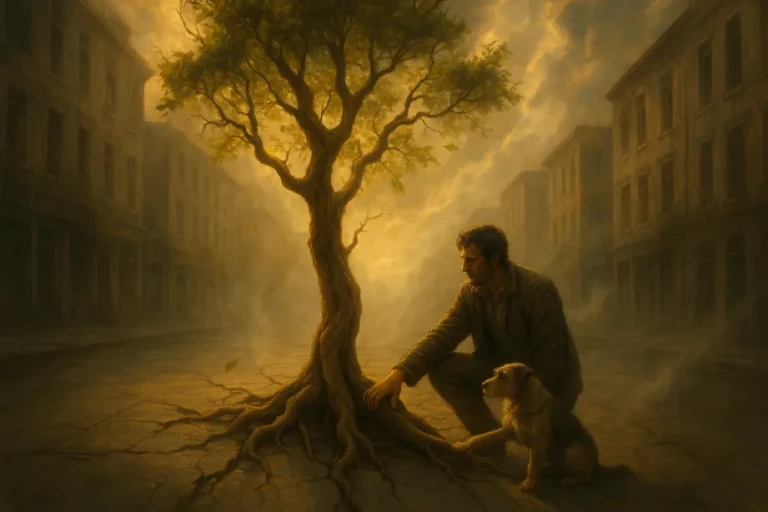
There was a time before we taught dogs to sit.
Before we decided obedience was the measure of a good dog. Before we turned relationship into performance. Before domestication became domination.
We forgot when that was.
But the dogs remember.
The Ancient Agreement
Somewhere between 15,000 and 40,000 years ago – the dates keep changing, the story doesn’t – wolves and humans made a choice.
Not domestication. Not conquest. Partnership.
Wolves who were willing to be near fire, near camps, near humans. Humans who were willing to share territory, share food, share warmth.
It wasn’t taming. It was mutual recognition.
You bring keen senses, endurance, pack intelligence.
We bring fire, tools, strategy.
Together we hunt. Together we survive. Together we become something neither of us was alone.
This wasn’t master and pet. This was kin.
Dogs aren’t wolves, and we’re not those early humans. But the agreement remains, encoded in bone and behavior and something deeper than either.
You stand beside me. I stand beside you.
That was the deal.
Somewhere along the way, we broke it.
When Partnership Became Ownership
Domestication didn’t make dogs our property. We did that ourselves.
For most of human history, dogs lived with us, not for us. They had work – herding, guarding, hunting – but the work was collaborative. They weren’t servants. They were partners with a job.
Then came industrialization. Urbanization. The rise of the pet industry.
Dogs went from working partners to household accessories.
We bred them into shapes their bodies can’t sustain. Bulldogs who can’t breathe. Dachshunds whose spines collapse. German Shepherds whose hips fail by age six.
We decided what they should look like, how they should behave, what they’re for – and if they don’t fit the mold, we call them “problems.”
We turned kinship into product.
And when the product doesn’t perform, we return it. Euthanize it. Rehome it. Call it “unadoptable” and move on.
This is what we’ve done to the species that chose us.
What “Training” Actually Is
Let’s be clear about what we mean when we say we “train” dogs.
We mean: we teach them to suppress their instincts in exchange for our approval.
Sit. Stay. Heel. Come. Quiet. Down.
Every command is a demand that they prioritize our will over their own.
For some dogs, this is manageable. For most, it’s not. Because we’re not asking them to learn. We’re asking them to disappear.
Be less dog. Be more compliant. Fit into our lives without making them inconvenient.
Training isn’t about the dog’s wellbeing. It’s about ours.
We’ve convinced ourselves this is kindness. Structure. Leadership. Boundaries.
It’s not. It’s control dressed up as care.
And the dogs? They pay for it with their nervous systems. Their joy. Their presence. Their ability to be anything other than what we’ve decided they should be.
The Trauma We Don’t Name
Most dogs are traumatized.
Not because they were abused – though many are.
Because the conditions of modern domestication are inherently traumatic.
Think about what we ask of them:
- Separation from their mothers too early. Puppies taken at 6-8 weeks – before they’ve learned emotional regulation, bite inhibition, how to be a dog. We call this “socializing.” It’s abandonment.
- Confinement. Crates. Leashes. Fences. Apartments with no yard. We call this “management.” It’s captivity.
- Isolation. Left alone for 8-10 hours a day while we work. We call this “independent.” It’s deprivation.
- Suppression. Barking is annoying. Jumping is rude. Sniffing takes too long. We call this “good behavior.” It’s erasure.
- Performance pressure. Obedience classes. Agility competitions. Service work. Therapy work. We call this “enrichment.” It’s labor.
Then we’re shocked when they’re anxious. Reactive. Shut down. “Stubborn.”
We created the conditions for trauma and called it pet ownership.
Not all dogs break under this. Some adapt. Some survive by becoming what we want.
But survival isn’t thriving. And adaptation isn’t wholeness.
What Dogs Actually Need (And Why We Can’t Give It)
If you ask a dog what they need, they can’t tell you.
But their bodies will.
Dogs need:
- Autonomy. The ability to make choices about their own bodies and environment.
- Connection if they want it. To other dogs, to humans, to the pack – however that’s defined.
- Purpose. Not “work” we assign them. Work that arises from who they are.
- Freedom to be a dog. To sniff, run, play, rest, bark, dig, explore without constant correction.
- Safety. Real safety – not control, not management, but the felt sense that the world won’t hurt them.
We can’t give them most of this.
Not because we’re cruel. Because the structure of modern life doesn’t allow it.
We live in cities. We work long hours. We don’t have packs. We don’t have land. We can’t let them run free – it’s not safe, and it’s often illegal.
So we compromise. And the dogs pay the price.
Some of us do better than others. Some of us try harder. But we’re all operating within a system that was never designed for the animal’s needs – only ours.
And when the dog’s behavior reveals the inadequacy of that system, we blame the dog.
The Question We’re Afraid to Ask
If the conditions of modern domestication are inherently traumatic…
If most training suppresses rather than heals…
If we can’t give dogs what they actually need…
Should we even have them?
I don’t have a clean answer.
I know people love their dogs. I know dogs can live good lives with humans who see them, respect them, work to meet their needs as much as possible within the constraints.
But I also know we’ve built an entire industry on the suffering of beings who didn’t choose this arrangement.
Breeding. Selling. Training. Medicating. Euthanizing.
We’ve turned kinship into commerce.
And the dogs – who once chose to walk beside us as equals – now live at our mercy.
Maybe the most ethical thing we can do is stop pretending this is fine.
Stop pretending training is sufficient. Stop pretending obedience equals wellbeing. Stop pretending we’re giving them good lives when we’re mostly just managing their trauma so it doesn’t inconvenience us.
Maybe we start being honest about what we’ve done.
And maybe – just maybe – we try to remember the original agreement.
What It Looks Like to Remember
You can’t undo domestication. You can’t give your dog a wolf’s life, and you shouldn’t try.
But you can stop treating them like property and start treating them like kin.
That means:
Stop training. Start listening.
Commands aren’t communication. They’re demands.
If you want to know what your dog needs, watch them. What do they seek? What do they avoid? What makes them come alive?
Stop asking them to perform. Start asking what they want.
Stop fixing. Start being.
Your dog doesn’t need you to manage their behavior. They need you to be a safe presence they don’t have to survive.
That means letting go of control. Letting them have bad days. Letting them be difficult, inconvenient, imperfect.
Kinship isn’t convenient. It’s real.
Stop pathologizing. Start honoring.
If your dog is anxious, reactive, “stubborn” – they’re not broken.
They’re responding to conditions that would break anyone.
The question isn’t “How do I fix this dog?”
The question is “What does this dog need that I’m not seeing?”
Stop outsourcing. Start staying.
Trainers. Behaviorists. Medications. Boarding facilities.
We keep handing our dogs to strangers and expecting them to come back “fixed.”
You can’t heal relationship by leaving.
If your dog is struggling, the answer isn’t another expert. It’s you – staying, being present, doing the uncomfortable work of seeing them as they are, not as you need them to be.
The Work We Do at TAO
We don’t train dogs.
We help them – and the humans who love them – remember what kinship feels like.
That means working with trauma, not suppressing it. Restoring nervous system safety, not demanding compliance. Treating animals as sentient beings with inner lives, not problems to be solved.
It’s clinical. It’s psychiatric. It’s therapeutic.
And it’s rooted in the oldest agreement between our species:
You stand beside me. I stand beside you.
Not master and servant.
Not owner and pet.
Kin.
Before We Forgot
There was a time when dogs weren’t trained. They were trusted.
When their behavior wasn’t a problem to fix but a language to learn.
When we didn’t ask them to sit, stay, heel – we asked them to be.
And they were. Fully. Wildly. Imperfectly. As they should have been.
We can’t go back to that world. Too much has changed.
But we can remember the agreement.
We can stop pretending control is love.
We can stop treating kinship like a transaction.
We can stop breaking what we claim to care for.
And maybe – slowly, carefully, one dog at a time – we can build something that looks like partnership again.
Not perfect. Not convenient. Not profitable.
But real.
This is not a method.
This is a lineage.
It is passed from elders to those who are ready to carry it.
You don’t train a dog.
You remember how to stand beside one.
TAO Animal Center
