
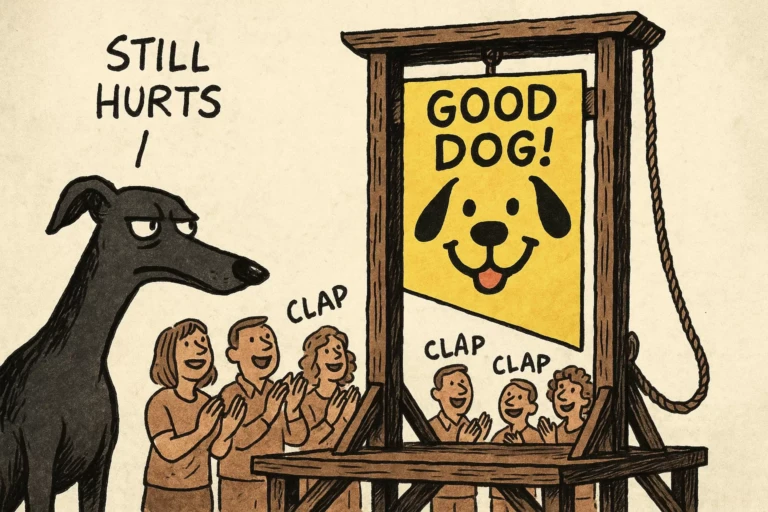
Watched the most bewildering training session today. A human instructor kept using phrases like “positive reinforcement” and “science-based methods” while systematically teaching a young Border Collie to stop thinking for herself.
The irony was so thick I could have chewed it.
Every few seconds: click, treat, click, treat. “Good girl! Yes! Perfect!” The dog’s eyes gradually went from bright and curious to glazed and mechanical. By the end, she was performing a flawless “sit-stay-come” routine with all the enthusiasm of a wind-up toy.
The human beamed with pride. “See how positive this is? No punishment at all!”
I nearly choked on the absurdity.
The Great Terminology Heist
Humans have pulled off the most impressive linguistic sleight-of-hand I’ve ever witnessed. They’ve taken the word “positive” – which used to mean something good, beneficial, uplifting – and turned it into a marketing term for manipulation.
Here’s what I observed in today’s “positive” training session:
– Constant interruption of natural behavior – Artificial rewards for artificial actions
– Systematic conditioning away from independent thought – Complete disregard for what the dog actually wanted to communicate – Reduction of a complex, intelligent being to a treat-dispensing performance
Apparently, as long as you’re not hitting someone, anything else qualifies as “positive.” Rather like calling a gilded cage “luxury housing.”
The Addiction Model
What struck me most was how closely this resembled what humans call “addiction.” The Border Collie had developed a dependency on external validation – clicks and treats – to know how to behave. Without constant reinforcement, she seemed lost, constantly looking to the human for the next hit of approval.
Independent thought? Gone. Natural problem-solving? Irrelevant. Personal agency? Who needs it when there are treats?
The trainer called this “building a strong foundation.” I called it “creating a functional addict.”
The Science Smokescreen
“This is all based on scientific research,” the instructor announced proudly, waving around what looked like a scientific journal.
I wanted to ask: research on what, exactly? Rats in mazes? Pigeons pecking buttons? When did we decide that laboratory studies on captive animals in artificial environments should dictate how free beings interact with each other?
It’s rather like using prison psychology to design marriage counseling.
What “Positive” Actually Looks Like
Later in the day, I witnessed something genuinely positive. A young child dropped their toy near my exhibit case. Their grandmother didn’t command, click, or treat. She simply said, “Oh, looks like your bear fell down. What should we do?”
The child thought for a moment, picked up the bear, and dusted it off. “There you go, bear.”
No conditioning. No external rewards. Just acknowledgment, respect for the child’s thinking process, and trust in their natural problem-solving abilities.
Revolutionary.
The Real Manipulation
Here’s what I’ve figured out about “positive reinforcement”: it’s not positive for the dog – it’s positive for the human’s conscience.
The human gets to feel good about themselves (“I’m not being mean!”) while still controlling every aspect of another being’s behavior. It’s manipulation with a smile, force with a treat attached.
The dog learns that their own thoughts, interests, and natural responses are irrelevant. What matters is performing whatever arbitrary action produces the magical click-treat combination.
Tell me again how this is positive?
The Thinking Alternative
What would genuinely positive interaction look like? I observed a fascinating example when the museum’s maintenance staff encountered a pigeon who’d wandered inside.
No clicking. No treating. No commanding.
Just observation: “What’s this little one trying to do?” Understanding: “Ah, looking for a way out.” Cooperation: “Let me open this door for you.” Respect: Waited patiently while the pigeon figured out the exit.
The pigeon left with dignity intact, problem solved through communication rather than conditioning.
The Uncomfortable Question
If your relationship with another being requires constant external rewards to function, is it actually a relationship? Or is it just a very elaborate form of bribery?
Real connection happens when someone chooses to engage with you because the interaction itself is worthwhile – not because they’ve been conditioned to expect treats for compliance.
What Happens When You Put the Clicker Away
I’ve seen it happen. Humans who dare to put down the treat pouch and pick up curiosity instead. Who ask “What are you thinking about?” instead of demanding immediate attention.
The results are always more interesting than any trained behavior could be.
The dog who was conditioned to “come” when called might ignore you completely when the treats run out. But the dog who chooses to check in with you because your interactions are genuinely engaging? That’s a companion worth having.
The Real Science
Here’s some actual science for you: intelligent beings thrive when their intelligence is acknowledged and engaged, not bypassed. They flourish when treated as thinking individuals, not biological machines to be programmed.
Revolutionary research, I know.
Try this experiment: for one week, interact with your companion without any artificial rewards or punishments. Just curiosity, respect, and genuine communication.
You might discover that what you thought was “positive training” was actually the most negative thing you could do to a thinking being – convince them that their own thoughts don’t matter.
Next time someone tries to sell you “positive reinforcement,” ask them this: positive for whom, exactly?

